
Flying With Hearing Aids: Airport Security and Air Travel Tips
You can wear hearing aids through airport security and for the entire flight. Security officers do not require you to remove them, and hearing aids are...
October 30, 2026 · 7 min read
145 N Marietta Pkwy NE, Suite E, Marietta, GA 30060
Hearing health
By Mark Stevenson, Hearing Instrument Specialist · October 30, 2026 · 7 min read
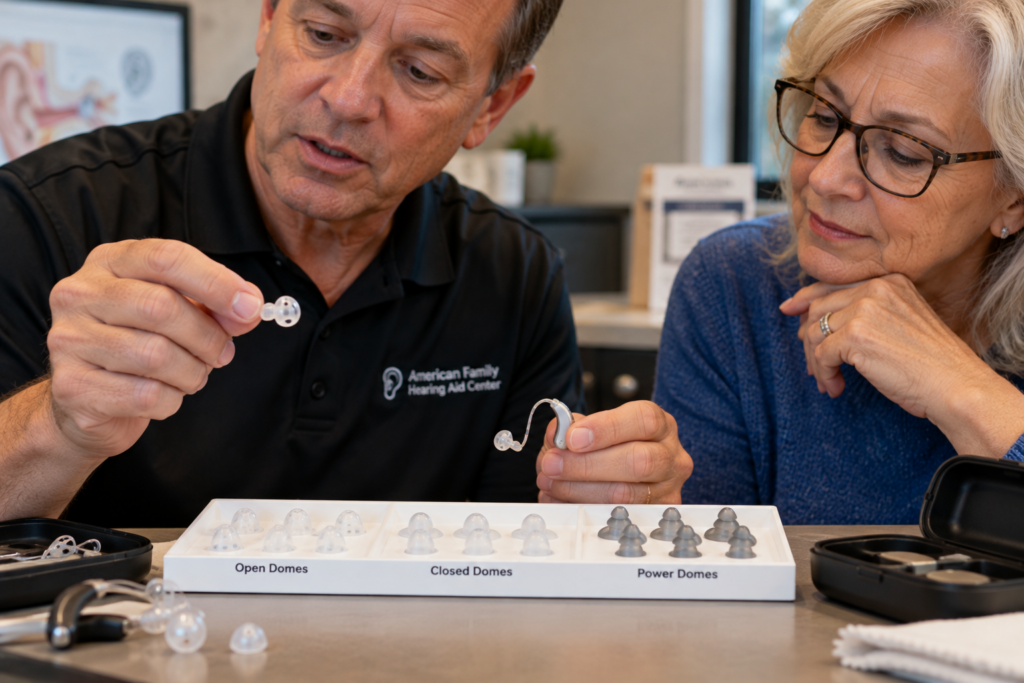
Hearing aid domes are the small silicone tips that hold the speaker in your ear canal. Open domes suit milder high-frequency loss, closed or tulip domes add low-frequency power, and power or double domes seal the canal for greater loss. Most domes should be replaced every one to three months. American Family Hearing Aid Center in Marietta, GA changes domes during a clean and check and makes custom ear molds when domes are not enough.
What Does a Hearing Aid Dome Do?
On receiver-in-canal and many behind-the-ear hearing aids, the speaker sits inside your ear canal, and the dome is the soft silicone tip that surrounds it. It holds the speaker in the right position, keeps it from touching the canal wall, and controls how much sound and air can pass around it.
That last job matters more than most people realize. The dome decides how much natural sound reaches your eardrum alongside the amplified sound, how much of your own voice echoes back, and how much amplified sound leaks out toward the microphone. The wrong dome can make a well-programmed hearing aid sound hollow, tinny or prone to whistling.
What Are the Different Types of Hearing Aid Domes?
Manufacturers use different names, but most domes fall into three groups:
The dome is chosen together with the device programming. Changing the dome type without adjusting the settings can make a hearing aid sound noticeably different, so it is best decided at a fitting.
How Do You Know Which Dome Size Is Right?
Domes come in several diameters, from small to large. The right size sits snugly without pressure: it stays in place when you chew, talk and turn your head, and you can wear it all day without soreness.
Ear canals are rarely identical, and your left and right ears may need different sizes. During a hearing aid fitting, real ear measurement confirms that the dome and programming together deliver the sound your prescription calls for.
Why Does Your Own Voice Sound Strange With Closed Domes?
If your voice sounds boomy, hollow or like you are talking with your head in a barrel, you are noticing the occlusion effect. When the canal is sealed, the low-pitched vibration of your own voice has nowhere to escape, so it seems louder to you than to anyone else.
Some occlusion is normal with closed and power domes, and most people stop noticing it within a few weeks. If it stays bothersome, a dome with more venting or a programming change often helps, as long as it does not take away the power your hearing loss needs.
How Often Should You Change Hearing Aid Domes?
Most domes should be replaced every one to three months, and sooner if you produce a lot of earwax. Silicone hardens and loses its shape over time, which affects both comfort and sound. Replace a dome straight away if it is:
How Do You Change a Hearing Aid Dome Safely?
That final tug matters. A dome that is not fully seated can stay behind in the ear canal when you remove the hearing aid.
What Should You Do If a Dome Gets Stuck in Your Ear?
Stay calm and leave it where it is. Do not use tweezers, cotton swabs or fingernails, which can push the dome deeper or scratch the canal. Call us at 770-590-8662, and we can usually see you promptly. If you have pain, bleeding or dizziness, contact a physician or urgent care.
When Is a Custom Ear Mold Better Than a Dome?
Domes suit most people, but not all. If your hearing aid keeps whistling, slips out, needs a lot of power, or your ear canal has an unusual shape, a custom ear mold made from an impression of your ear often solves it. Our earlier article explains what custom ear molds are and who benefits most.
How Do Wax Filters Work With Domes?
Underneath most domes sits a tiny wax filter, sometimes called a wax guard. It stops earwax from reaching the speaker, which is the most delicate and expensive part to replace. When the filter fills up, sound becomes weak or muffled, and many people mistake a blocked filter for a failing hearing aid.
Check the filter every time you change a dome, and replace it whenever it looks dark or blocked. Filters are specific to each manufacturer, so use the ones designed for your device. If you produce a lot of wax, filters may need changing every few weeks, and a regular ear cleaning appointment reduces how quickly they clog.
Why Does a New Dome Feel Different at First?
A fresh dome is softer and slightly fuller than one that has been worn for weeks, so it can feel snugger for the first day or two. Sound may also seem a little brighter, because a new dome seals the way it was designed to. Both are normal and usually settle quickly.
If a new dome still feels uncomfortable after a few days, or sound seems very different, it may be a different size or type than the one you had before. Bring the packaging to your next visit so we can confirm it matches your fitting.
Get the Right Dome Fitted in Marietta
We stock domes and wax filters for the hearing aids we fit, and we can check the fit of devices bought elsewhere. Call 770-590-8662 or schedule a consultation at our Marietta office, 145 N Marietta Pkwy NE, Suite E. Directions and parking are on our Marietta location page.
You can, but buy the exact type and size your hearing aid was fitted with. Domes are not universal across brands, and switching type can change how your hearing aid sounds. We can tell you exactly which domes you use.
No. Each manufacturer designs domes to fit its own speakers, and sizes vary. Using the wrong dome can leave it loose, which risks it staying in your ear.
A new dome that is the wrong size, not fully seated, or more open than your old one can let sound leak and cause whistling. Reseat it firmly, and if it continues, the size or type may need adjusting.
Yes, if the dome is too large, hardened with age or holding wax against the skin. A fresh dome in the right size usually fixes it. Persistent itching or pain should be checked.
Open domes let more natural sound through, including some background noise, which helps sound feel natural. Modern noise reduction features work alongside them, and your settings can be adjusted if noise bothers you.
Wipe them daily with a dry cloth or tissue and brush away wax with your cleaning tool. Avoid water and alcohol on the hearing aid. Replace the dome when wax will not wipe away.
Do not try to dig it out. Call us at 770-590-8662 so it can be removed safely. If you have pain, bleeding or dizziness, contact a physician.
Every one to three months for most people, and sooner if you produce a lot of earwax or the dome hardens, splits or loosens.
Hearing Instrument Specialist with more than 25 years in hearing healthcare, and the person who runs every hearing test, fitting and adjustment at American Family Hearing Aid Center in Marietta. A Hearing Instrument Specialist tests hearing and fits hearing aids. We do not diagnose medical ear conditions, and we refer to a physician when something needs one.
This article is general information, not medical advice about your own hearing. If you have sudden hearing loss, one-sided loss, ear pain or drainage, contact a doctor promptly.
You can wear hearing aids through airport security and for the entire flight. Security officers do not require you to remove them, and hearing aids are...
October 30, 2026 · 7 min read
People with arthritis or low vision usually do best with rechargeable hearing aids, slightly larger receiver-in-canal or behind-the-ear styles, and smartphone or remote controls instead of...
October 30, 2026 · 7 min read
Most people should not sleep with hearing aids in. Overnight wear keeps the ear canal warm and damp, can cause soreness and whistling against the pillow,...
October 30, 2026 · 7 min read
A consultation takes about 45 minutes, and you leave with an audiogram and a plain explanation of it.