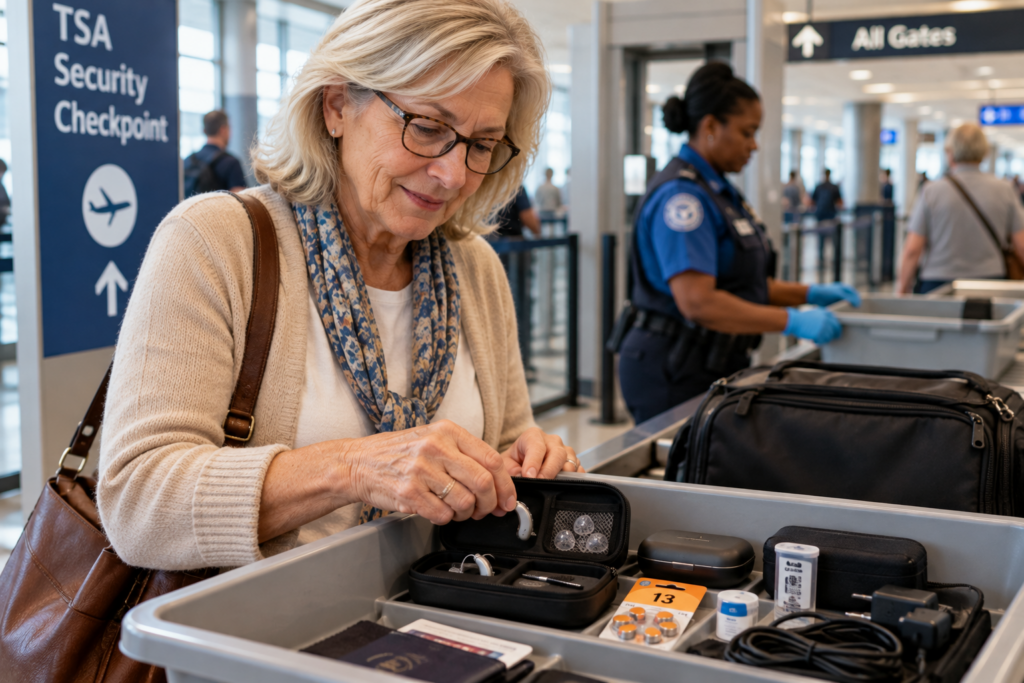
Flying With Hearing Aids: Airport Security and Air Travel Tips
By Mark Stevenson, Hearing Instrument Specialist · October 30, 2026 · 7 min read
You can wear hearing aids through airport security and for the entire flight. Security officers do not require you to remove them, and hearing aids are permitted onboard. Pack chargers, spare batteries, domes and a drying case in your carry-on. American Family Hearing Aid Center in Marietta, GA can check your devices before a trip with a clean and check and help you set up Bluetooth hearing aids for travel.
Can You Wear Hearing Aids Through Airport Security?
Yes. You do not need to take your hearing aids out to pass through a metal detector or body scanner, and doing so only makes them easier to lose. At a busy airport like Hartsfield-Jackson, where checkpoints move quickly and instructions are shouted over noise, keeping them in helps you follow what officers are saying.
Tell the officer that you wear hearing aids before you walk through, especially if you have difficulty hearing instructions. If a device is noticed during screening, it may be checked by sight or with a light swab, which takes a moment. Travelers who want extra help can contact TSA Cares at 855-787-2227 before their trip to arrange assistance at the checkpoint.
Keep your hearing aid case in a zipped pocket rather than in the screening bin with your shoes and keys. Small cases are easy to leave behind at a crowded checkpoint, and losing one on the way out of security is far more common than any problem with the scanner itself.
Can You Wear Hearing Aids on the Plane?
Yes. Hearing aids are allowed throughout the flight, including takeoff and landing. If your hearing aids connect to your phone over Bluetooth, follow the crew’s instructions for personal devices. Some hearing aids have their own flight mode, and many airlines now allow Bluetooth connections in flight.
Wearing them on board also helps with safety. Cabin announcements are often hard to hear over engine noise, and you will want to catch instructions from the crew, gate changes and connection information.
How Do You Hear Announcements at the Airport and on Board?
Tell the gate agent you have hearing loss and ask them to let you know about boarding and gate changes in person.
Turn on alerts in your airline’s app, so gate changes and delays appear on your phone.
Watch the departure screens rather than relying on overhead announcements.
Let a flight attendant know when you board, and choose a seat where you can see the crew if possible.
What Should You Pack for Your Hearing Aids?
Keep everything for your hearing aids in your carry-on, never in checked luggage. Bags get delayed, and a missing charger can leave you without hearing for days. A simple packing list:
Charger and cable for rechargeable devices, plus a plug adapter for international trips
Spare batteries in their original packaging for battery devices
Extra domes and wax filters
A cleaning brush and cloth
A drying case or electronic dryer for humid destinations
A hard storage case, so the devices have a safe place when you sleep or swim
Spare lithium batteries and power banks must go in your carry-on under airline rules. If your hearing aid charger has a built-in battery, keep it in your carry-on bag too. Label the case with your name and phone number, so a lost case can find its way back to you.
Can Cabin Pressure Affect Your Hearing Aids or Your Ears?
Cabin pressure changes do not harm hearing aids. Your ears are a different matter: during climb and descent, the pressure behind the eardrum has to equalize, which causes the familiar popping or fullness. Swallowing, yawning, chewing gum or sipping a drink during descent all help.
If you have a cold or blocked sinuses, equalizing is harder and flying can be painful. Ear fullness or muffled hearing that lasts more than a day or two after a flight is worth having checked by a physician.
How Do You Protect Hearing Aids From Heat, Moisture and Loss While Traveling?
Never leave hearing aids in a parked car. A Georgia summer car interior can damage electronics and batteries quickly.
Use your drying case every night, especially at the beach or in humid climates.
Take hearing aids out before swimming, showering or using a hot tub, unless they are rated for it.
Store them in the same place in every hotel room, so they never end up wrapped in sheets or towels.
Start with the basics: a fresh battery or full charge, a clean wax filter and a new dome solve most problems. Our guide on why a hearing aid stops working walks through the most common fixes. If that does not help, call us at 770-590-8662 and we can talk you through it or arrange a repair when you are home.
Hearing aids fitted at our office include manufacturer warranty and loss and damage coverage for a set period, so a device lost or damaged on vacation is not the end of the story. Keep your device details and our phone number with your travel documents.
How Can You Hear Better in Noisy Airports and on the Plane?
Airports and aircraft cabins are among the hardest places to follow conversation. Engine noise, echoing terminals and constant announcements all compete with the person next to you. A few settings make a real difference:
Switch to a noise or restaurant program, if your hearing aids have one, to focus on voices in front of you.
Sit facing your travel companion and away from the aisle when you can.
Use a remote microphone accessory clipped to your companion for long conversations.
Stream audio from your own phone or tablet straight to your hearing aids for movies and podcasts.
Seatback entertainment systems usually do not connect to hearing aids directly. Downloading shows to your own device before you leave, then streaming them through your hearing aids, is often the easiest way to watch in flight.
What Should You Do Before Leaving Home?
Charge your hearing aids fully the night before, and check that your phone app is updated and connected. Pack your supplies the same day you pack your medications, so nothing gets left on the bathroom counter. If you will be away for more than a week, bring enough domes, filters and batteries for the whole trip plus a few spares.
Get Your Hearing Aids Ready Before You Fly
A quick check a week or two before a trip means fresh filters and domes, a confirmed charge and settings that suit the noisy places you will visit. Call 770-590-8662 or schedule a consultation at our Marietta office, 145 N Marietta Pkwy NE, Suite E. Directions and parking are on our Marietta location page.
Frequently Asked Questions
Do I need to remove my hearing aids for the airport body scanner?
No. You can keep your hearing aids in through metal detectors and body scanners. Let the officer know you wear them, and expect a quick visual check if needed.
Can hearing aids go through the X-ray machine?
Yes. Carry-on X-ray screening does not harm hearing aids, chargers or batteries. Most people simply keep their hearing aids in their ears and send the charging case through with their bag.
Can I wear my hearing aids during takeoff and landing?
Yes. Hearing aids are permitted for the entire flight. Follow crew instructions about Bluetooth connections to your phone, and use your hearing aid’s flight mode if it has one.
Should I pack hearing aid batteries in checked luggage?
No. Keep spare batteries, chargers and supplies in your carry-on, so a delayed bag never leaves you without hearing. Spare lithium batteries and power banks must travel in the cabin.
Should I tell the airline that I have hearing loss?
Yes. Telling the gate agent and flight attendants means they can share boarding calls, gate changes and safety instructions with you directly.
Will my hearing aid charger work in another country?
Most chargers accept the range of voltages used worldwide, but you will need a plug adapter for the wall socket. Check the label on your charger, or ask us before you travel.
What happens if I lose a hearing aid while traveling?
Hearing aids fitted at our office include loss and damage coverage for a set period. Call us at 770-590-8662 as soon as you can, and keep your device details with your travel documents.
Can I sleep on the plane with my hearing aids in?
A short nap upright is usually fine. For long overnight flights, store them in their case once you have heard the safety briefing. Our guide on sleeping with hearing aids explains why.
Mark Stevenson, HIS
Hearing Instrument Specialist with more than 25 years in hearing healthcare, and the person who runs every hearing test, fitting and adjustment at American Family Hearing Aid Center in Marietta. A Hearing Instrument Specialist tests hearing and fits hearing aids. We do not diagnose medical ear conditions, and we refer to a physician when something needs one.
This article is general information, not medical advice about your own hearing. If you have sudden hearing loss, one-sided loss, ear pain or drainage, contact a doctor promptly.
People with arthritis or low vision usually do best with rechargeable hearing aids, slightly larger receiver-in-canal or behind-the-ear styles, and smartphone or remote controls instead of...
Hearing aid domes are the small silicone tips that hold the speaker in your ear canal. Open domes suit milder high-frequency loss, closed or tulip domes...
Most people should not sleep with hearing aids in. Overnight wear keeps the ear canal warm and damp, can cause soreness and whistling against the pillow,...
October 30, 2026 · 7 min read
Find out where your hearing actually stands
A consultation takes about 45 minutes, and you leave with an audiogram and a plain explanation of it.
To provide the best experiences, we use technologies like cookies to store and/or access device information. Consenting to these technologies will allow us to process data such as browsing behavior or unique IDs on this site. Not consenting or withdrawing consent, may adversely affect certain features and functions.
Functional
Always active
The technical storage or access is strictly necessary for the legitimate purpose of enabling the use of a specific service explicitly requested by the subscriber or user, or for the sole purpose of carrying out the transmission of a communication over an electronic communications network.
Preferences
The technical storage or access is necessary for the legitimate purpose of storing preferences that are not requested by the subscriber or user.
Statistics
The technical storage or access that is used exclusively for statistical purposes.The technical storage or access that is used exclusively for anonymous statistical purposes. Without a subpoena, voluntary compliance on the part of your Internet Service Provider, or additional records from a third party, information stored or retrieved for this purpose alone cannot usually be used to identify you.
Marketing
The technical storage or access is required to create user profiles to send advertising, or to track the user on a website or across several websites for similar marketing purposes.