What Are Custom Ear Molds and Who Should Consider Them?
By admin, Hearing Instrument Specialist · September 29, 2026 · 5 min read
Custom ear molds are precisely fitted devices made from a silicone impression of an individual’s ear canal. They are used forhearing aids,ear protection, musician’s plugs, and swim plugs.American Family Hearing Aid CenterinMarietta, GAtakes ear impressions in-office and provides a range of custom mold options tailored to each patient’s needs.
The Basics: What a Custom Ear Mold Is
A custom ear mold is a precisely fitted device created from a physical impression of an individual’s ear canal and, depending on the application, the outer portion of the ear. Because the human ear canal is as unique as a fingerprint, two people with apparently similar ear sizes will have canal shapes that differ in curvature, diameter, texture, and length in ways that make off-the-shelf products fit imperfectly. American Family Hearing Aid Center in Marietta takes ear impressions in-office for the full range of custom mold applications.
A custom mold eliminates that variability. Whether the mold is used for a hearing aid, for noise protection, for swimming, or for in-ear audio monitoring, it fits the individual’s anatomy precisely. The result is better performance, better comfort, and better consistency than any universal product can provide.
Types of Custom Ear Molds and Their Uses
Hearing Aid Ear Molds: For patients with hearing aids, custom ear molds provide the coupling between the hearing aid and the ear canal. Not all hearing aid users need a custom mold, many behind-the-ear devices use standard domes, but patients with moderate to severe hearing loss, those with a history of fit or feedback problems, and those with unusually shaped ear canals often benefit from a custom mold that provides a better seal, more comfort, and a more stable fit.
Custom Noise Protection: Custom molds for ear protection offer a consistent, comfortable seal for workers and recreationists in loud environments. Because the fit is molded to the individual’s anatomy, protection is reliable and consistent in a way that foam plugs cannot match. Applications include industrial and construction work, shooting sports, motorcycle riding, and concert or festival attendance.
Musician’s Ear Molds: Musicians’ earplugs use a flat-attenuation filter mounted in a custom mold. The filter reduces sound levels across all frequencies evenly, preserving the tonal balance and clarity of music while reducing the overall volume to safe levels. This is dramatically different from foam earplugs, which muffle high-frequency sounds disproportionately and distort the sound of music. Professional musicians, sound engineers, and dedicated concert-goers rely on musician’s molds to protect hearing without compromising their experience.
Swim Plugs: Custom swim plugs are designed to keep water out of the ear canal. They are made from a waterproof material and molded to fit securely without putting pressure on the ear. They are particularly important for patients with ear tubes, a perforated eardrum, or a history of recurrent outer ear infections, for whom water entry into the ear canal can cause significant problems.
In-Ear Monitor Molds: Musicians and audio professionals who use in-ear monitors, either for stage performance or studio monitoring, commonly use custom molds to hold the monitors in place and improve sound isolation. The custom fit provides a seal that dramatically reduces ambient noise, allowing monitors to be used at lower and safer volumes.
How the Impression Process Works
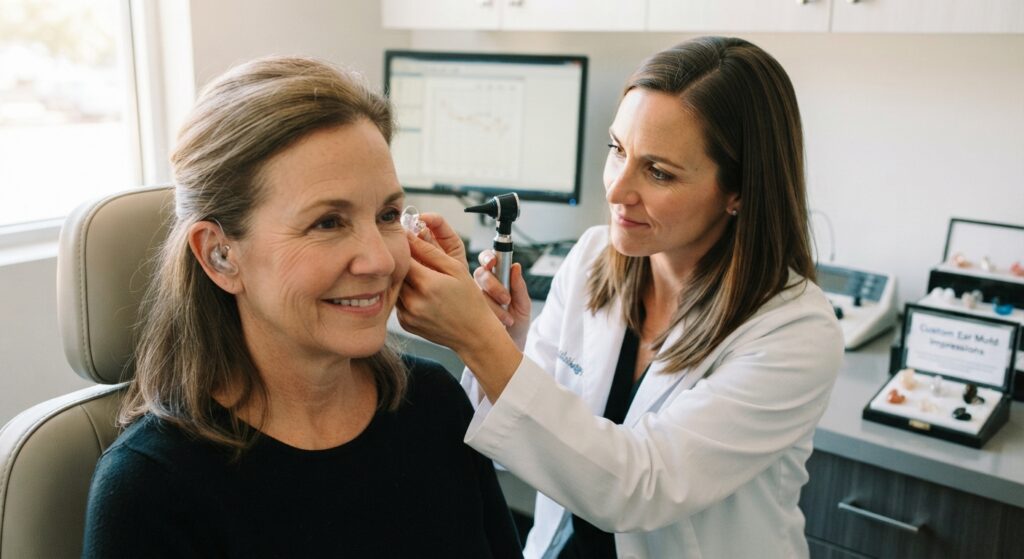
Getting a custom ear mold begins with an ear impression. At American Family Hearing Aid Center in Marietta, the provider first examines the ear canal to confirm it is clear of wax and ready for impression taking. A small foam or cotton dam is gently placed in the canal to protect the eardrum.
A fast-curing silicone material is then injected into the ear canal and outer ear. The material conforms to every contour of the anatomy as it sets, which takes only a few minutes. Once set, the impression is gently removed. The process is comfortable throughout and most patients are surprised by how easy it is.
The impressions are sent to a specialized lab where the finished mold is fabricated. Depending on the type of mold and the lab’s turnaround time, patients typically receive their custom molds within one to two weeks.
Who Should Consider Custom Ear Molds
Custom ear molds are worth considering for any of the following situations:
Hearing aid users who have experienced feedback, fit problems, or discomfort with standard domes. Patients with moderate to severe hearing loss who need a better seal for adequate amplification. Workers or recreational users exposed to regular loud noise who find foam earplugs uncomfortable or inconsistent. Patients with ear tubes, perforated eardrums, or chronic ear infections who need reliable protection from water. Musicians or music enthusiasts who want high-fidelity hearing protection.
Scheduling at American Family Hearing Aid Center
The team at American Family Hearing Aid Center in Marietta provides ear impressions and custom mold services for a range of applications. Whether you need molds for a new set of hearing aids, for workplace noise protection, for water sports, or for music, the clinic can take the impressions and guide you through the options.
Contact the clinic to schedule an ear impression appointment or to discuss which type of custom mold fits your needs.
Frequently Asked Questions
What is a custom ear mold?
A custom ear mold is a device made from an impression of an individual’s ear canal and outer ear. It is fabricated to fit that specific anatomy precisely and is used for hearing aids, ear protection, musician’s plugs, swim plugs, and in-ear monitors.
Who needs a custom ear mold for a hearing aid?
Not all hearing aid users need a custom mold. Patients with moderate to severe hearing loss, those who have had fit problems with standard domes, and those who benefit from a better seal or more power often receive custom molds as part of their hearing aid fitting.
Does getting an ear impression hurt?
No. The impression process is painless. The provider places a small foam dam in the canal to protect the eardrum, injects fast-curing silicone that sets in a few minutes, and gently removes the mold. The entire process is comfortable.
How long do hearing aid ear molds last?
Hearing aid ear molds typically last two to five years. The material can harden or discolor over time, and the ear canal shape can change, affecting comfort and performance. The team at American Family Hearing Aid Center can assess whether a mold needs replacement at each visit.
Can I get custom ear molds for earbuds?
Yes. Custom molds for earbuds and in-ear monitors provide superior sound isolation and comfort compared to standard tips and are popular with musicians, audio professionals, and audiophiles who use them frequently.
Are custom ear molds covered by insurance?
Coverage depends on the reason for the mold and the insurance plan. Ear molds that are part of a hearing aid fitting may be covered under hearing aid benefits. Custom ear protection is typically not covered. American Family Hearing Aid Center can help clarify coverage before your appointment.
Mark Stevenson, HIS
Hearing Instrument Specialist with more than 25 years in hearing healthcare, and the person who runs every hearing test, fitting and adjustment at American Family Hearing Aid Center in Marietta. A Hearing Instrument Specialist tests hearing and fits hearing aids. We do not diagnose medical ear conditions, and we refer to a physician when something needs one.
This article is general information, not medical advice about your own hearing. If you have sudden hearing loss, one-sided loss, ear pain or drainage, contact a doctor promptly.
Hearing aids are among the most effective tools for managing tinnitus when hearing loss is also present. By amplifying environmental sound, they reduce the contrast that...
Ringing in the ears, known as tinnitus, is most commonly caused by noise-induced hearing loss, age-related hearing changes, or earwax buildup. American Family Hearing Aid Center...
Custom ear protection outperforms generic earplugs in comfort, consistency, and hearing protection because it is molded precisely to the individual's ear canal. American Family Hearing Aid...
September 29, 2026 · 5 min read
Find out where your hearing actually stands
A consultation takes about 45 minutes, and you leave with an audiogram and a plain explanation of it.