
Home › Hearing Aids › Rechargeable
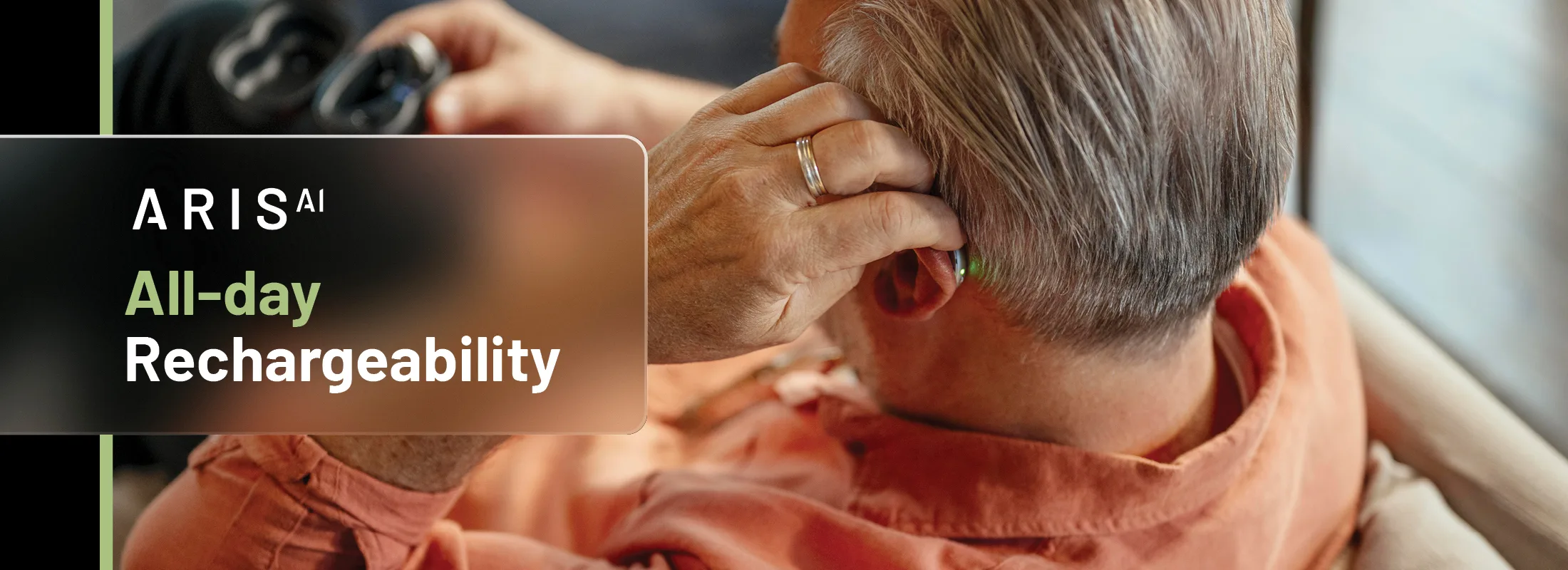
Rechargeable Hearing Aids
Drop them in a case at night and take them out in the morning. No tiny doors, no size-10 batteries, and nothing to fumble with on the kitchen counter at seven in the morning.
IN SHORT
Rechargeable hearing aids use a sealed lithium-ion cell instead of disposable batteries. You place them in a charging case overnight and take them out in the morning. Audibel rates its current receiver-in-canal models at up to 51 hours per charge and its custom in-ear models at up to 38 hours. For anyone with arthritis or reduced vision, they are substantially easier than size-10 batteries.
All-day power
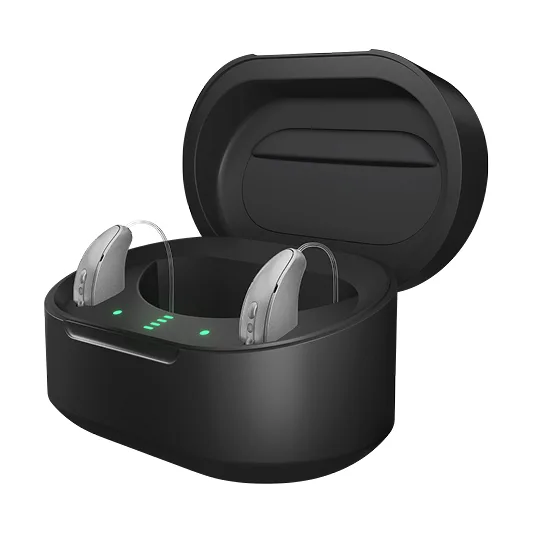
Listen, stream and go all day on a single charge. The receiver-in-canal models are the workhorses of the range and cover mild through severe hearing loss.
- Audibel rates the Aris AI receiver-in-canal at up to 51 hours on one charge
- Available across the Aris AI, Vitality AI, Intrigue AI and Signature Series lines
- The premium charger holds enough power for three additional full charges away from a wall outlet
Rechargeable custom options
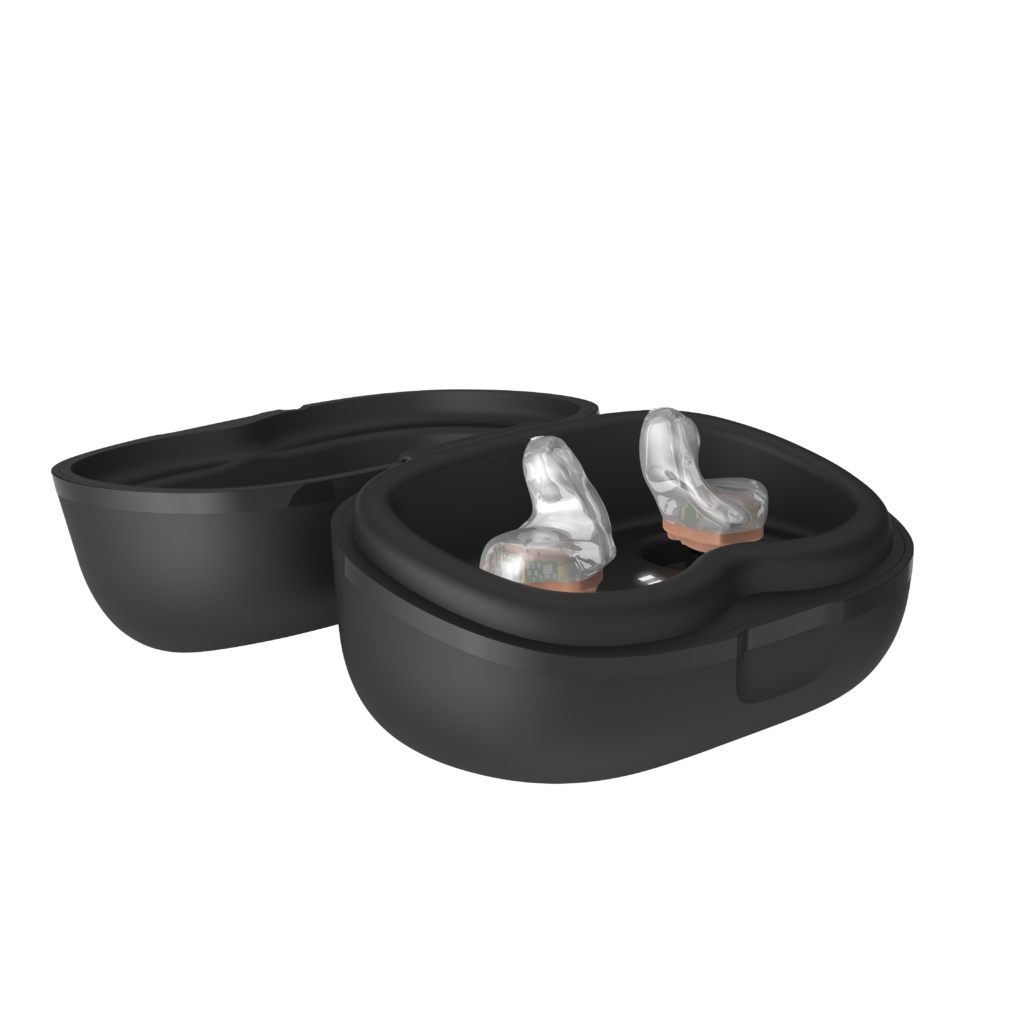
Rechargeable used to mean behind the ear. Audibel was the first manufacturer to put a rechargeable cell into a custom in-ear device, which matters if you wear glasses or a mask all day.
- Sit completely in the ear, so nothing competes with glasses or a mask
- Audibel rates the custom models at up to 38 hours on one charge
- A range of shell colors, whether you want it discreet or visible
- Available across the Aris AI, Vitality AI, Intrigue AI and Signature Series lines
What those numbers mean in practice
The 51 and 38 hour figures are Audibel’s ratings under their test conditions, and they are genuinely good. What they assume is modest wireless use. If you stream television for three hours and take an hour of hands-free calls, expect meaningfully less. Nobody in the industry quotes streaming-heavy runtime, so it is worth knowing before you are surprised by it.
In practice the number that matters is not the maximum, it is whether the device comfortably clears your waking day with margin. For almost everyone, on any current rechargeable, it does. Tell us how much you stream at the fitting and we will factor it in.
The habit that makes it work
Put the charger somewhere you cannot miss it: beside the bed, or next to the coffee maker. Patients who tie charging to something they already do every night almost never run out. Patients who keep the charger in a drawer do.
Rechargeable or disposable batteries?
Both are still fitted, and the right answer depends on your hands, your eyes and how you live. This is the honest comparison.
| Rechargeable | Disposable batteries | |
|---|---|---|
| Daily runtime | Up to 51 hours (RIC) or 38 hours (custom), per Audibel. Heavy streaming reduces it. | Roughly 3 to 7 days per size-10 battery, depending on the device |
| Handling | Drop into a case. Nothing small to open, hold or drop. | A size-10 battery is about 5mm across, with a tab to peel |
| If you forget | Most chargers give several usable hours from a 30-minute top-up | Swap in a spare, if you have one with you |
| Running cost | No batteries to buy. Cell replaced by the manufacturer at around 4 to 5 years. | Roughly 100 batteries per pair per year for a typical wearer |
| Moisture resistance | Sealed case with no battery door, which resists sweat and humidity better | A battery door is another opening for moisture to get in |
| Availability | Most receiver-in-canal, behind-the-ear and many custom in-ear models | Every style, including the smallest invisible-in-canal devices |
Audibel lines with rechargeable options
Rechargeable is available across the range rather than being reserved for the top tier. Intrigue AI also offers it, alongside the three shown here.

Audibel Aris AI

Audibel Signature Series

Audibel Vitality AI
Are rechargeable hearing aids right for me?
How long do rechargeable hearing aids last on one charge?
Audibel rates its receiver-in-canal models at up to 51 hours and its custom in-ear models at up to 38 hours. Heavy Bluetooth streaming shortens that noticeably, so if you stream for hours daily, mention it and we will factor it in.
What happens if I forget to charge them?
Most chargers deliver several hours of use from a 30-minute top-up, so a forgotten night is usually recoverable. There is no spare battery to swap in, which is the main practical difference from disposables.
Can the rechargeable battery be replaced?
Yes, but by the manufacturer rather than at home. Cells generally need replacing after around four to five years as capacity fades, and we handle sending them in.
Are rechargeable hearing aids more expensive?
Rechargeable models often sit slightly higher at the same technology level, but you stop buying disposable batteries. Over four or five years the running cost usually evens out.
Can I get rechargeable in a custom in-ear style?
Yes. Audibel was the first to put a rechargeable cell into a custom in-ear device, so it is no longer a behind-the-ear-only feature. The very smallest invisible-in-canal devices still use disposable batteries, because there is no room for a cell.
Do they work if I travel?
Yes. The premium charger holds enough for around three more full charges away from a wall outlet, which covers most trips and a Georgia power cut.
Hold one before you decide
Two minutes with a charger and a device in your hand tells you more than any spec sheet. Come in and try it, and bring the person who will be reminding you to charge it.